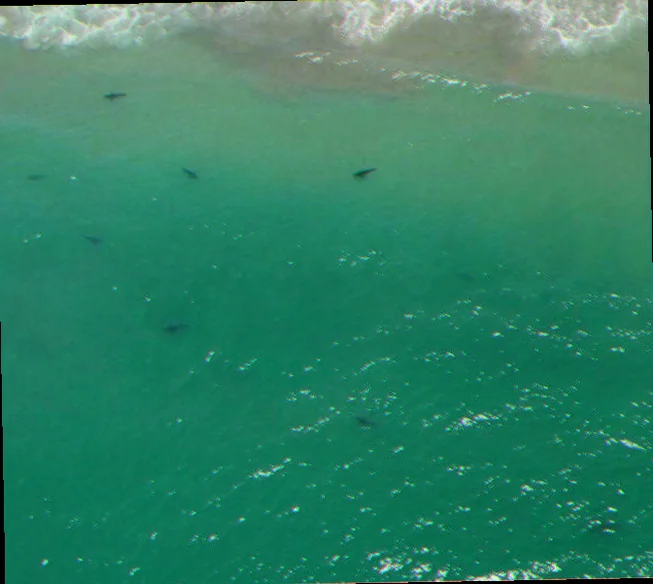
Field impression: The sun glints off the shallow, clear water, revealing the subtle ripple of sand on the seabed. Suddenly, a darker shadow detaches itself from the bottom, a quick, purposeful dart of a slender form, barely disturbing the water. A tell-tale V-shaped wake briefly expands before dissipating, as the juvenile shark melts back into the sun-dappled camouflage of the shallows, a silent, efficient hunter moving with an ancient grace.
How to Identify Juvenile shark behaviour near shore
| Feature | What to Look For |
|---|---|
| Body shape | Typically fusiform (torpedo-shaped) for fast-moving species like Blacktip Reef Sharks (Carcharhinus melanopterus), or flattened and more robust for bottom-dwellers such as Port Jackson Sharks (Heterodontus portusjacksoni) or various Wobbegongs (genus Orectolobus). Look for a distinct caudal (tail) fin providing propulsion, and prominent dorsal fins. |
| Colouration | Most juveniles display countershading - darker on top (dorsal) and lighter underneath (ventral) - to blend with both the surface light and the darker seabed. Many species, particularly those favouring reefs or sand, exhibit species-specific markings like dark fin tips (Blacktip Reef), saddle-like bands (Port Jackson, Wobbegong), or subtle mottling. These patterns are often more distinct in juveniles, aiding camouflage in complex nursery habitats. |
| Size compared to common object | Nearshore juveniles typically range from 20 cm to 70 cm in length, depending on the species and stage of development. This is roughly the size of a substantial Bream (Acanthopagrus butcheri) or a large Barramundi (Lates calcarifer) for the bigger juveniles. Smaller individuals might be comparable to a large hand-span. |
| Voice / sound | Sharks are largely silent. Any 'sound' will be the subtle displacement of water as they move, perhaps a soft 'swish' if they rapidly accelerate or turn in very shallow water, or the splash of small prey scattering in their path. |
| Tracks / signs | Direct tracks are rare, but observers might note disturbed sand or sediment where a shark has rested or foraged on the bottom. The most common sign is a sudden, momentary scattering of small schooling fish (e.g., mullet, silversides) or prawns, followed by a fleeting shadow or rapid wake in the water. |
Where and When to Find It
Juvenile sharks are most frequently encountered in specific, sheltered nearshore environments that serve as vital nursery grounds. These areas provide abundant food, warmer waters, and crucial protection from larger predators. In Australia, prime locations include extensive mangrove estuaries, shallow sand flats adjacent to seagrass meadows, sheltered bays with rocky substrates, and even large, deep rock pools at low tide.
Specific bioregions and locations where these behaviours are commonly observed include the vast seagrass beds and protected channels of Moreton Bay, Queensland, which are critical nurseries for species like juvenile Lemon Sharks (Negaprion brevirostris) and Blacktip Reef Sharks. In Port Stephens, New South Wales, the sheltered inner harbour and its surrounding estuaries provide refuge for juvenile Port Jackson Sharks and various Wobbegongs. The expansive intertidal zones and sheltered embayments of Shark Bay, Western Australia, are renowned for their juvenile Lemon and Tiger Sharks (Galeocerdo cuvier). Even the temperate waters of Spencer Gulf, South Australia, host juvenile Bronze Whaler Sharks (Carcharhinus brachyurus) in its extensive tidal creek systems.
The best months for observation are typically the warmer periods from late spring through summer and early autumn (October to April), when water temperatures are conducive to growth and prey abundance is high. Observations are most frequent during daylight hours, especially during rising or falling tides when prey is concentrated in shallower waters, making foraging more efficient. Early morning and late afternoon (crepuscular periods) often yield increased activity as ambient light levels are optimal for hunting without attracting undue attention from larger predators.
Behaviour Worth Watching
- Unique behaviour 1: Sand-Ripple Camouflage Drift: This behaviour is particularly noticeable in species such as juvenile Shovelnose Rays (often mistaken for sharks due to their body form, e.g., Glaucostegus typus) and some bottom-dwelling sharks like Wobbegongs. The juvenile actively positions itself in areas with strong, consistent currents over sandy or silty bottoms where natural sand ripples are pronounced. Instead of active swimming, the shark uses the current to slowly drift, often slightly angled, allowing its countershading and patterns to merge almost perfectly with the moving sand. Periodically, it will execute a sudden, short burst of speed, covering only a meter or two, to intercept a passing small fish or crustacean, before settling back into the current to continue its 'drift'. This conserves energy and maximises the surprise element for prey, blending dynamic movement with static camouflage.
- Unique behaviour 2: Sentinel Pairing (or Triad) in Micro-Habitats: In very confined, sheltered micro-habitats such as large tidal pools, small mangrove channels, or under rocky ledges, juvenile Port Jackson Sharks (Heterodontus portusjacksoni) or even juvenile Grey Nurse Sharks (Carcharias taurus) in rare instances, can exhibit a subtle, coordinated vigilance. One or occasionally two individuals position themselves at a slightly elevated point or a more exposed vantage, such as the edge of a rock pool or just outside a dense patch of seagrass. They remain relatively still, facing outwards, while the other one or two individuals actively forage or rest deeper within the cover. After a period, the roles may subtly rotate, with the 'sentinel' moving to feed and another taking its place. This isn't a complex social structure, but an opportunistic, low-energy form of shared vigilance against aerial or aquatic predators in vulnerable, enclosed spaces.
- Social structure: While adult sharks are often solitary, many juvenile sharks aggregate in nursery areas for safety and abundant food. These aggregations are typically loose, not forming tight schools, and individuals mostly forage independently. However, the density of juveniles in a nursery can be quite high, leading to frequent, though usually brief, interactions over prey or territory.
- Defensive display: When threatened, juvenile sharks exhibit rapid, evasive actions. This usually involves an immediate, powerful dart into deeper water, dense seagrass beds, or mangrove root systems. Bottom-dwelling species like Wobbegongs or Port Jackson Sharks may flatten themselves against the substrate, relying heavily on their camouflage, or even partially bury themselves in sand or mud, kicking up sediment to obscure their retreat. They rarely display overt aggressive postures unless directly handled or cornered.
- Activity pattern: In nursery areas, juvenile sharks are often diurnal or crepuscular (active at dawn and dusk). This pattern is driven by a balance of prey availability (many small fish and crustaceans are active during these times) and reduced risk from larger, nocturnal predators. Warmer water temperatures in shallow nurseries also support higher metabolic rates, allowing for more sustained daytime activity compared to adults in deeper, cooler waters.
Ecological Role in the Australian Landscape
Juvenile sharks play a crucial role as mesopredators within their nearshore ecosystems. They primarily act as "clean-up crew" and population regulators, preying on small fish, crustaceans, and molluscs. By selectively targeting smaller, slower, or less vigilant individuals, they contribute to the health and vigour of prey populations, preventing overpopulation and potentially culling diseased or genetically weaker individuals. For example, juvenile Blacktip Reef Sharks feeding on small schooling fish in mangrove estuaries help maintain the balance of these fish populations, which might otherwise deplete primary producers like zooplankton and phytoplankton. Their foraging activities, particularly those of bottom-dwellers, can also contribute to small-scale sediment disturbance, which can release nutrients back into the water column for primary producers. They are a vital link in the food web, transferring energy from lower trophic levels to higher ones, and their presence is a strong indicator of a healthy, functioning coastal ecosystem.
Lookalikes and How to Tell Them Apart
Observing juvenile sharks near shore can sometimes lead to confusion with other marine life:
- Juvenile Rays and Skates (e.g., Shovelnose Rays, Stingrays): These are frequently mistaken for sharks, especially the streamlined shovelnose species. The key distinguishing feature is their body shape: rays and skates have flattened bodies with their pectoral fins greatly expanded and fused to their heads, forming a distinct disc or diamond shape. Sharks, conversely, have a more cylindrical or fusiform body with distinct, separate pectoral fins. While shovelnose rays have a somewhat shark-like tail, their broad, flattened head and body are unmistakable upon closer inspection.
- Large Schooling Fish (e.g., Juvenile Trevally, Mullet): Large individual fish or tight schools of fish can sometimes create a similar shadow or wake in shallow water. However, the behaviour is usually distinct. Fish like trevally tend to school tightly and move in synchronous