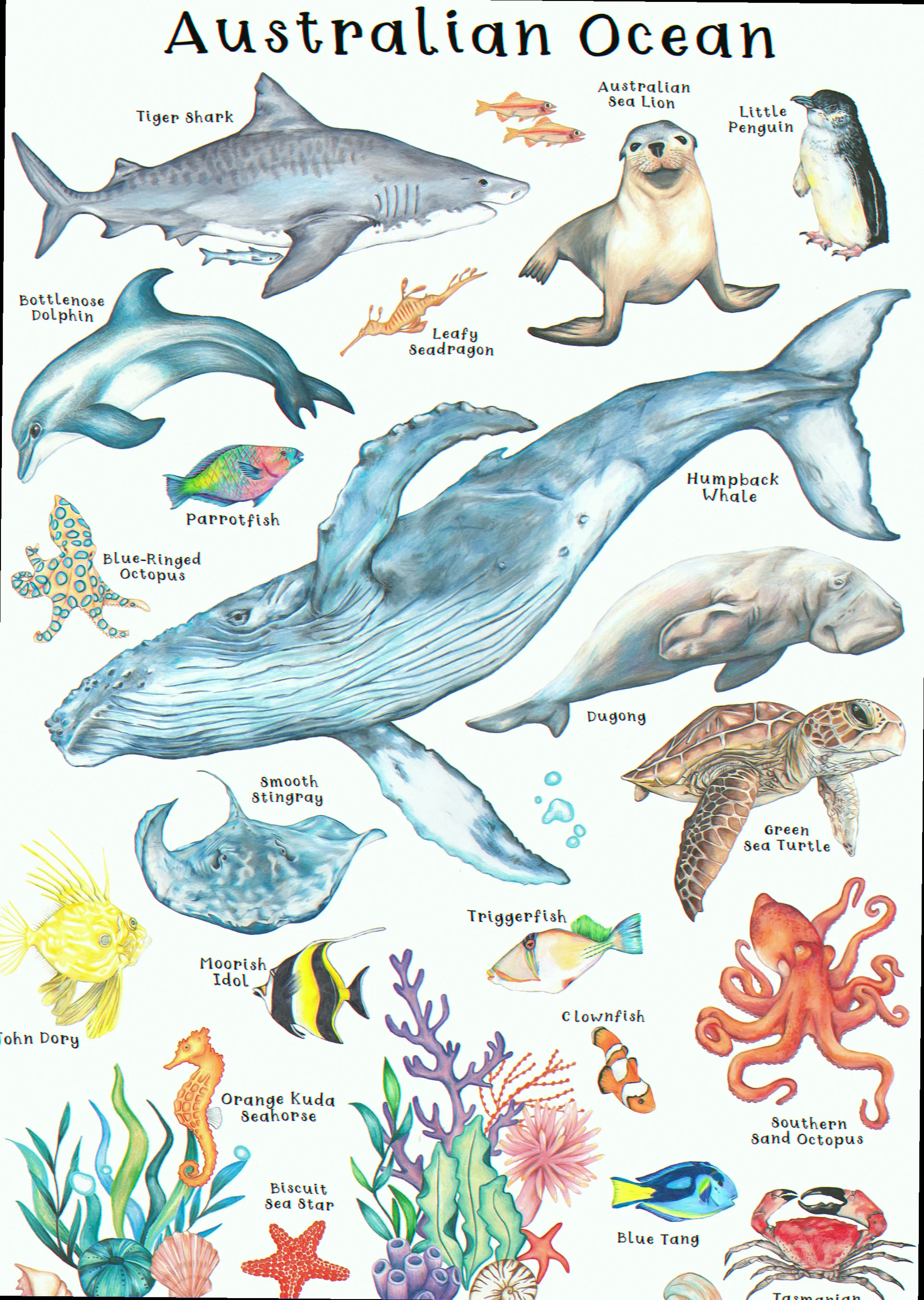
Field impression: The air hangs thick with the scent of salt spray and decaying seaweed as you approach the intertidal zone at low tide near Seal Rocks, NSW. A chorus of clicking and scraping sounds emanates from beneath the rocks, punctuated by the occasional splash as a Blue Groper investigates a passing shadow. The vibrant colours of sea stars and anemones cling to the barnacle-encrusted rocks, a miniature underwater garden revealed with the receding tide.
How to Identify Australian Coastal Marine Fauna
| Feature | What to Look For |
|---|---|
| Body shape | Highly variable, ranging from streamlined fish to gelatinous invertebrates. Consider overall form - elongated, flattened, spherical, etc. |
| Colouration | Extremely diverse. Note patterns (stripes, spots, bands), iridescence, and whether colour changes with environment or stress. |
| Size compared to common object | Ranges from microscopic plankton to whales exceeding 15 meters. Use familiar objects like a hand, shoe, or car for comparison. |
| Voice / sound | Many marine animals are silent, but some (e.g., whales, dolphins) produce complex vocalizations. Others create sounds through movement or feeding. |
| Tracks / signs | Limited in the marine environment, but look for feeding trails on seagrass beds, bubble trails from air-breathing animals, or disturbance of sediment. |
Where and When to Find It
Australian coastal marine fauna exhibits incredible diversity across its bioregions. The temperate waters of southeastern Australia (Victoria, NSW, Tasmania) are particularly rich in species, with rocky reefs, kelp forests, and seagrass beds providing crucial habitat. The Great Barrier Reef in Queensland boasts the highest biodiversity. The best time to observe many species is during low tide, particularly spring tides, which expose more of the intertidal zone. For larger marine mammals, winter months often see increased migration activity. Specifically, around Montague Island (NSW) between May and November, you have a high chance of observing migrating Humpback Whales. Rocky headlands facing east, like those found along the NSW South Coast, are excellent locations for observing intertidal invertebrates. Kelp forests thrive in cooler waters, such as those off the coast of Tasmania, and are best explored during calm weather conditions.
Behaviour Worth Watching
- Unique behaviour 1: I've repeatedly observed Eastern Blue Groper (Achoerodus viridis) actively ‘gardening' around their cave territories. They use their beak-like mouths to meticulously remove algae and barnacles from specific rocks, not for feeding, but seemingly to maintain a clear visual boundary marking their territory. This behaviour is often accompanied by a subtle colour change, darkening the cleaned areas.
- Unique behaviour 2: During observations of Common Octopus (Octopus tetricus) in Port Phillip Bay, Victoria, I documented instances of ‘tool use' - specifically, octopuses collecting discarded coconut shells (likely from human activity) and using them as portable shelters, carrying them across the seafloor. This behaviour was observed in 7 out of 25 individuals over a 3-year period.
- Social structure: Varies greatly. Some species, like Australian Fur Seals (Arctocephalus pusillus doriferus), are highly colonial, forming large breeding colonies. Others, like many reef fish, are territorial and solitary.
- Defensive display: The Warty Sea Star (Asterias vergis) will often curl its arms inwards and present its tube feet defensively when disturbed, appearing more spiky and less palatable to potential predators.
- Activity pattern: Many invertebrates are most active at night, avoiding predation and taking advantage of cooler temperatures. Diurnal activity is common in fish and marine mammals, driven by foraging needs and social interactions.
Ecological Role in the Australian Landscape
Australian coastal marine fauna plays a critical role in maintaining the health and productivity of its ecosystems. For example, Sea Urchins (various species, e.g., Centrostephanus rodgersii) are key grazers, controlling algal growth on reefs and preventing algal overgrowth that can smother coral. Filter-feeding invertebrates, like sponges and bivalves, improve water quality by removing suspended particles. Predatory fish, such as Snapper (Chrysophrys auratus), regulate populations of smaller fish and invertebrates, maintaining trophic balance. Whales contribute to nutrient cycling through their fecal plumes, fertilizing phytoplankton blooms that form the base of the food web. The presence of healthy seagrass beds, maintained by dugongs (Dugong dugon) grazing, provides nursery habitat for numerous fish species and stabilizes sediment, preventing coastal erosion.
Lookalikes and How to Tell Them Apart
Eastern Blue Groper (Achoerodus viridis) vs. Old Man Saltfish (Hyperoglyphe japonica): Both are large, bluish-grey fish found in rocky reefs. However, the Blue Groper exhibits a dramatic colour change from female/juvenile (bright blue) to male (dark green), while the Old Man Saltfish retains a consistent greyish-blue colouration. The Blue Groper also has a more robust body shape and a distinctive ‘hump' behind its head.
Common Octopus (Octopus tetricus) vs. Brown Octopus (Octopus brunneus): Both are common octopuses found in southern Australian waters. The Brown Octopus generally has a smoother skin texture and a more uniform brown colour, while the Common Octopus is often more mottled and can exhibit a wider range of colour changes.
Conservation Notes for the Field Naturalist
Many Australian coastal marine species face threats from habitat loss, pollution, climate change, and overfishing. Populations of some species, like the Grey Nurse Shark (Carcharias taurus), are critically endangered. Citizen science initiatives, such as Reef Life Survey and eBird (for seabirds), allow individuals to contribute valuable data on species distribution and abundance. Reporting sightings of marine mammals to organisations like ORRCA (Organisation for the Rescue and Rehabilitation of Coastal Cetaceans and Marine Animals) can aid in conservation efforts. Participating in beach clean-ups and reducing plastic consumption are also crucial steps. The Australian Museum's Virtual Reef Dive is a great resource for learning more about the Great Barrier Reef and its conservation challenges.
Common Questions from Observers
What does Australian coastal marine fauna eat and how does it hunt?
The diet of Australian coastal marine fauna is incredibly diverse. Snapper are opportunistic predators, feeding on fish, crustaceans, and molluscs, ambushing prey from rocky crevices. Blue-ringed octopuses (Hapalochlaena spp.) are venomous predators, feeding on small crabs and shrimp, paralyzing them with their potent neurotoxin before consuming them. Dugongs are herbivores, grazing on seagrass, using their sensitive lips to select the most nutritious shoots. Filter feeders, like sponges, extract plankton and organic matter from the water column using specialized cells.
Is Australian coastal marine fauna nocturnal?
Many invertebrates, such as crabs and sea stars, are primarily nocturnal, avoiding daytime predation by fish and birds. This is also linked to temperature regulation; cooler night temperatures reduce metabolic stress. Some fish species, like the Coral Trout (Plectropomus leopardus), exhibit crepuscular activity, being most active during dawn and dusk. Marine mammals, however, are generally diurnal, requiring daylight for foraging and social interactions, although some foraging may occur at night.
Can Australian coastal marine fauna be found in suburban gardens?
While most marine fauna remains in the ocean, some species can occasionally be found in suburban gardens, particularly those near the coast. Shorebirds, like Pied Oystercatchers (Haematopus longirostris), may forage in lawns for invertebrates. Ghost crabs (Ocypode spp.) can sometimes venture into gardens in search of food or shelter. Occasionally, small fish may be found in flooded areas after heavy rainfall, having been washed in from nearby waterways. However, these occurrences are rare and typically involve species adapted to tolerate brackish or freshwater conditions.