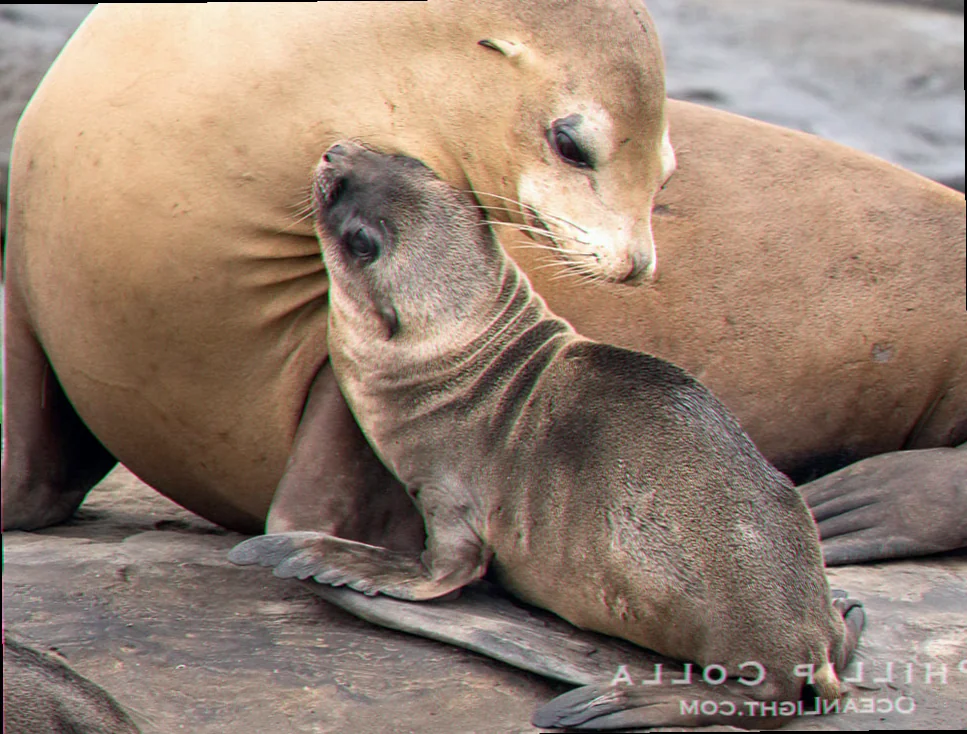
Field impression: The air at a South Australian breeding colony carries a pungent, wild scent of fermented fish and salty ammonia, dominated by the rhythmic, lamb-like bleating of chocolate-brown pups. You see these small, velvety bundles tucked into the shadows of limestone overhangs or sprawled in the white sand, their bodies twitching in a deep, restorative sleep while the turquoise Southern Ocean surges nearby. The soundscape is a chaotic mix of the heavy "ark-ark" barking of territorial bulls and the high-pitched, desperate calls of youngsters seeking their mothers among the dunes.
How to Identify Monitoring health of sea lion pups
| Feature | What to Look For |
|---|---|
| Body shape | Stocky and robust with a blunt, dog-like muzzle; pups have a rounded "pot-belly" when healthy and well-fed. |
| Colouration | Newborns (pups) are a rich, dark chocolate brown; they moult into a creamy silver-grey coat with a pale throat after 4-5 months. |
| Size compared to common object | At birth, they are roughly the size of a Cocker Spaniel, weighing between 6 and 10 kilograms. |
| Voice / sound | A distinctive, high-pitched bleat or "baaa" used to signal mothers; healthy pups are vocal and persistent. |
| Tracks / signs | Parallel "haul-out" drags in the sand where the belly rubs, flanked by the characteristic "push" marks of the fore-flippers. |
Where and When to Find It
The Australian Sea Lion (Neophoca cinerea) is one of the world's rarest pinnipeds and is endemic to Australian waters. Monitoring efforts are concentrated primarily along the coastline of South Australia and Western Australia. Key locations for observing pup health include Seal Bay on Kangaroo Island, the Dangerous Reef in the Spencer Gulf, and the Houtman Abrolhos islands off the Western Australian coast. Unlike most seals that breed annually, these animals follow a unique 17.6-month breeding cycle. This means "pupping season" shifts throughout the calendar year, making it essential to consult local park registries. Pups are best observed in the "creche" zones-sheltered limestone caves or the lee of saltbush (Atriplex) scrub-during the early morning or late afternoon when they are most active before the heat of the day sets in.
Behaviour Worth Watching
- Unique behaviour 1: Sand-crusting for Thermoregulation: Pups are frequently observed using their fore-flippers to flick damp, cool sand onto their backs. This is not mere play; it creates a "sand-crust" that acts as a natural evaporative cooler. A healthy pup will actively manage its temperature this way, whereas a lethargic or sickly pup may remain exposed to the sun, leading to rapid dehydration.
- Unique behaviour 2: Bubble-blowing Socialization: In tide pools, pups engage in "bubble-blowing" contests. They submerge their muzzles and exhale slowly to create streams of bubbles, which they then chase. Naturalists believe this serves as a critical developmental milestone for breath control and sensory coordination required for later benthic foraging.
- Social structure: Highly social but dependent; pups form "creches" or small playgroups with other youngsters while their mothers are at sea foraging for 2-3 days at a time.
- Defensive display: When threatened, a pup will tuck its nose under its flippers and emit a sharp, raspy "hiss" or "cough," an attempt to mimic the sound of a much larger adult to deter terrestrial predators like birds of prey.
- Activity pattern: Cathemeral (active intermittently day and night). Their activity is dictated by their mother's return; they must be ready to suckle immediately upon her arrival to maximize nutrient intake.
Ecological Role in the Australian Landscape
Monitoring the health of sea lion pups provides a "canary in the coal mine" for the Southern Ocean's health. As apex predators, sea lions concentrate nutrients from the deep sea and deposit them onto nutrient-poor coastal fringe environments. Pups contribute to this via the "nutrient pump" mechanism; the urea and scat they deposit in the dunes provide essential nitrogen and phosphorus to coastal vegetation like Sea Rocket and Spinifex. This fertilization stabilizes dune systems against erosion. Furthermore, the pup mortality rate serves as a direct indicator of the abundance of benthic (seafloor) prey species like octopus and rock lobster. If pups are underweight, it often signals a collapse in the local marine food web or a rise in sea surface temperatures affecting prey distribution.
Lookalikes and How to Tell Them Apart
The most common lookalike is the Long-nosed Fur Seal (Arctocephalus forsteri). You can tell them apart by the profile of the face: the Australian Sea Lion pup has a blunt, "puppy-dog" muzzle and a flat forehead, whereas the Fur Seal has a very pointed, almost fox-like snout. Additionally, sea lion pups tend to stay in the sandy dunes or limestone caves, while Fur Seal pups are more frequently found on rugged, steep granite rock platforms closer to the splash zone.
Conservation Notes for the Field Naturalist
The Australian Sea Lion is currently listed as Endangered. The population is estimated at only 10,000 to 12,000 individuals. The primary threats are entanglement in lost fishing gear (ghost nets) and the "colony-specific" nature of their breeding; females return to the exact beach where they were born, meaning if a local colony is wiped out, it is rarely recolonized. Field naturalists can assist by using citizen-science apps like "iNaturalist" to record sightings of tagged pups. Monitoring pup health involves looking for "Body Condition Scores"-if the ribs or hip bones are visible through the fur, the pup is likely malnourished. Reporting entanglements to the National Parks and Wildlife Service immediately can save an individual's life.
Common Questions from Observers
What does Monitoring health of sea lion pups eat and how does it hunt?
Pups are entirely dependent on their mother's milk, which is exceptionally high in fat (up to 40%), for the first 12 to 18 months of their lives. As they reach weaning age, they begin to "gum" at seaweed and eventually hunt small crustaceans and mollusks in shallow rock pools, practicing the "pin and tear" technique used by adults to consume octopus.
Is Monitoring health of sea lion pups nocturnal?
While pups are active at various times, their mothers are primarily nocturnal or crepuscular foragers. Pups spend much of the night huddling together for warmth in the dunes, becoming most vocal and active at dawn when they anticipate their mothers returning from the night's hunt.
Can Monitoring health of sea lion pups be found in suburban gardens?
No. Unlike some seal species in the Northern Hemisphere, Australian Sea Lions are extremely wary of human infrastructure. They require pristine, undisturbed sandy beaches and offshore islands. They are never found in suburban environments, and any sea lion found near human habitation is likely a "vagrant" or a sick animal in need of professional veterinary intervention.